
Gone Boys
World's Largest Hot Dog

David OReilly, in his 2008 essay “Basic Animation Aesthetics”, wrote about the then-current trend of pushing towards photo-realism in digital animation.
“My central idea in constructing the world of the film was to prove that something totally artificial and unreal could still communicate emotion and hold cinematic truth. The film makes no effort to cover up the fact that it is a computer animation, it holds an array of artifacts which distance it from reality, which tie it closer to the software it came from. This idea is in direct opposition to all current trends in animation, which take the route of desperately trying to look real, usually by realistic lighting and rendering, or by forcing a hand-made or naive appearance. At the time of writing, this trend shows no apparent signs of ceasing.”1
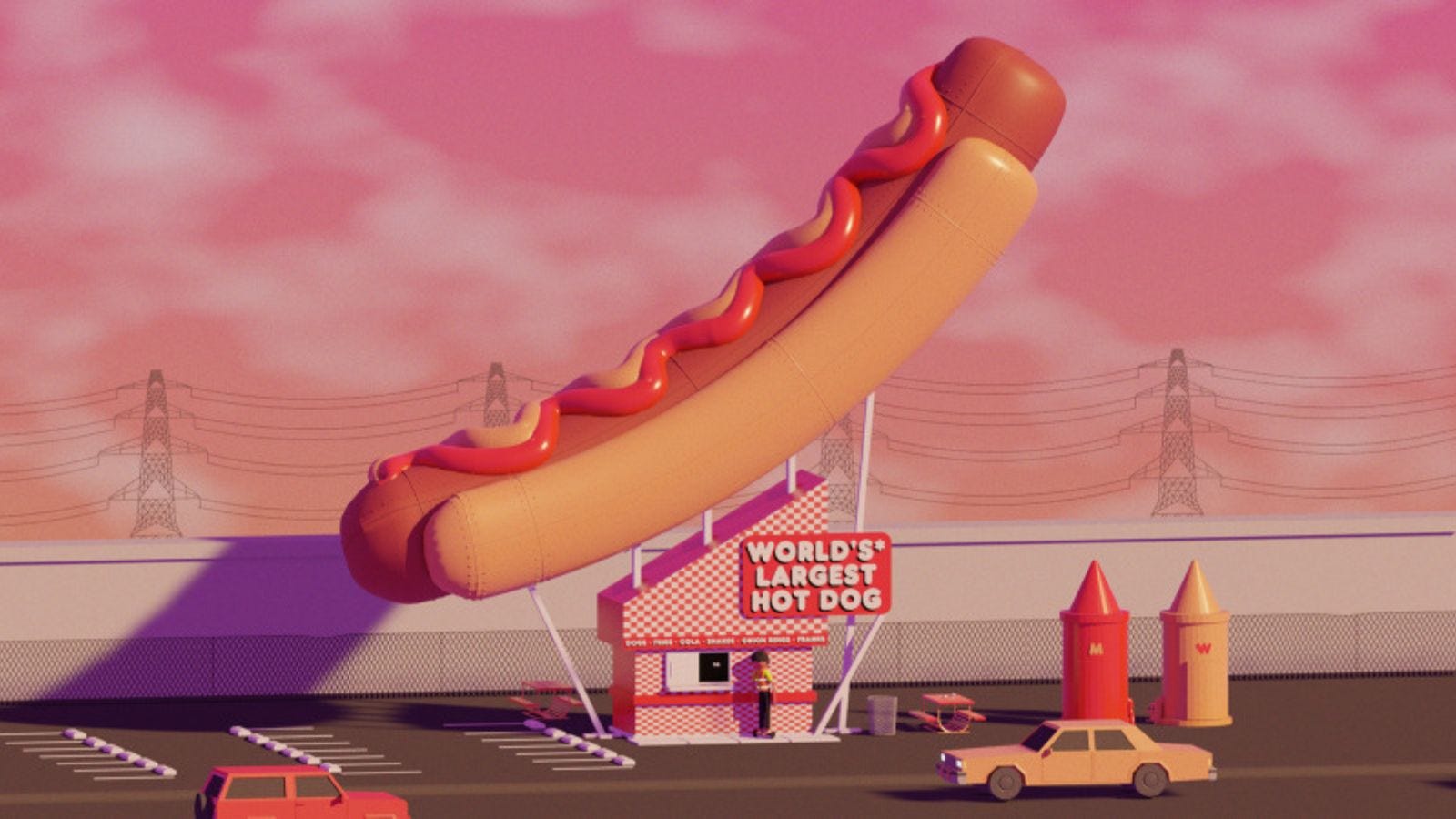
This may have been tempered a bit in the past decade. From Cloudy with a Chance of Meatballs (2009) to Into the Spiderverse (2018), Hollywood animation has embraced cartooning beyond the drive to mimic the material. Character design has evolved. Rubbery cartoon acting creeps in beside bio-real mechanics. The aesthetics of the blockbuster animation remain firmly encamped in the pursuit of the naturalistic. They ask “how would anthropomorphic creatures behave in a world kind of like ours BUT IF we shifted the parameters of reality just a bit?”.
Since 2020 Dreamworks has aimed to keep production budgets under $100,000,000,000. That’s one hundred million dollars. The Bad Guys 2 reportedly cost $80 million. Walt Disney Animation still exceeds these costs,2 same with Pixar.3 The extraordinary investment in these projects presents an opportunity for extraordinary loss. Hollywood cartoons exist as business propositions, investments. Institutional investors -$100,000,000 would probably qualify (I’m not a finance bro) -tend to be long term strategists, they tend to mix stability with short term volatility that may have payoff down the road. Film producers don’t have long term vision. Without immediate returns they may be out of work. So they lean on “stability”. They produce work with a guarantee for quick return on their investment. Experimentation and exploring the boundaries of the medium typically don’t bring in big audiences.4
The choices, with both dollars and ideas, have ossified in the past 40 years with the financialization of economy. As we measure fiscal health by the flow of dollars, when a billionaire banks $50,000,000 from Disney dividends that’s “better for the economy” than 100 people earning $250,000 for a year’s labor. This factors in public policy to promote the interests of entities with a lot of cash. The numbers don’t care where the money goes, as long as it moves. Political figures can point to the GDP, they can point to Wall Street, they can point to the record flow of currency and say, “Look! Booming economy!”. This financialization has been a key factor in our current economic failure. It’s a foundational reason for wealth disparity. It’s big reason why fewer things get made. When pure financial transactions hold the same weight as actual production (P = product in “GDP”), leaning on financial transactions will make that line go up farther and faster. It pulls capital from production towards finance. It creates a crisis for the worker. The impact of the economic crisis has even led David OReilly to move away from animation.5
The Hollywood model for animated film is to spend a lot of money to make a lot of money for a few people. Eggs in basket. Basket in golden carriage.
In genre filmmaking, notably but not exclusively horror, a different model surfaces. Blumhouse6 is a case study. Their biggest budget, $48,000,000 for Tooth Fairy (2010), was one their first films. Likely well into production before Paranormal Activity (2009), made for less than 1% of Tooth Fairy’s budget, became a cash-printing machine. Since that early film Blumhouse has produced dozens of films for under $10,000,000 and have been in mostly in the $10-$20 million range since 2020. Their system is to make a lot of work for less money, relying on one of those films to hit. Like buying a lot of lottery tickets. In the Blumhouse model, it’s like buying a lot of lottery tickets when you already know what a half of the numbers will be. Spreading $200,000,000 over 10 projects fosters better economic conditions for film workers and reduces the value extracted by pure finance rentiers.
Cartuna’s model may not be the same as Blumhouse, maybe due to access to capital, maybe for other reasons. But the producer nods in their direction while backing and distributing unorthodox material. We’ve worked with them on Penny Lane’s Nuts and other, non-theatrical projects.7 From our experience, a Paranormal Activity budget would be welcomed on many of their films. Without public numbers, I can’t say how economically viable their approach is. As a film-goer, I appreciate it.
Boys Go to Jupiter, distributed by Cartuna and in current release, was created, written and animated by Julian Glander. Techfolks will note he uses Blender, the same free software behind last year’s Oscar-winning Flow. Animationfolks will note the paucity of walks, replaced with Segways and skateboards.
Somewhere David OReilly dismissed digital artwork that pretends it’s not made with a computer. I can’t find that reference, so maybe it was in conversation or a public talk. In his Basic Animation Aesthetics he does say, “In general I always feel that any filter that appears to easily add a lot of beauty to an image or 3d model should be avoided, itʼs usually a sign that the base material isnʼt that good in the first place.” OReilly’s work is all angles. His aesthetic explored the boundaries of technology in a time when pixel pushing was an obstacle for independent artists. His work emerges entirely from the digital box, sculpting polygons like Brancusi to a bronze.
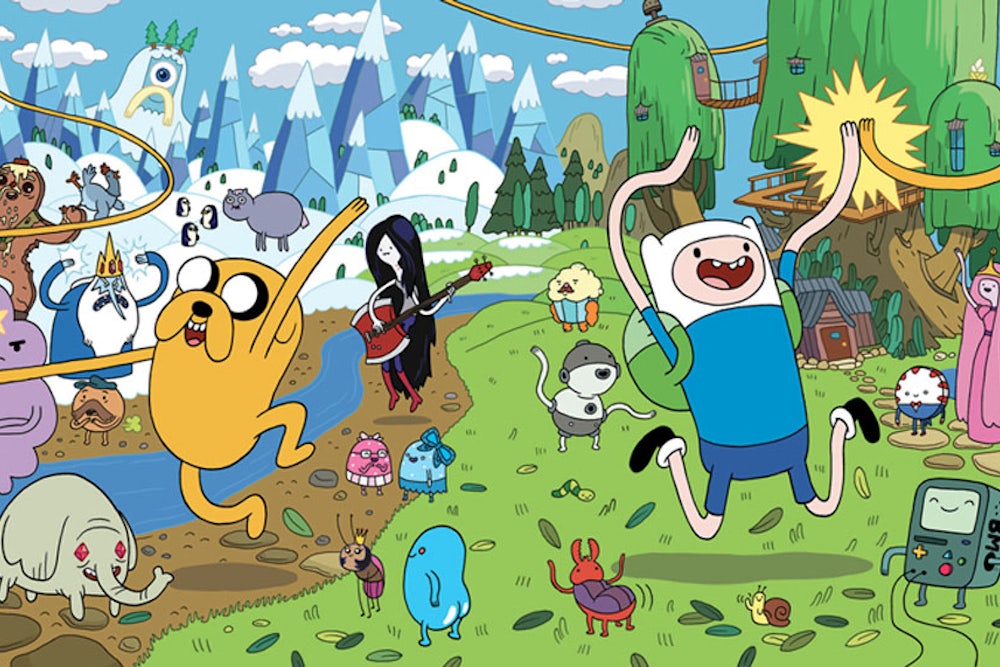
Julian Glander’s aesthetic rounds those corners. The design is infused with softness. The look is in conversation with recent cartoon media like Adventure Time (Incidentally, OReilly created an episode of this show). The look has a broad appeal to an audience that came of age in 21st Century.
As the national economy grinds the animation artist, Boys Go to Jupiter looks like a possible path to keep the art form viable. Boutique productions at lower costs than the high price/high return Hollywood films. Boys Go to Jupiter, produced at around 10 times the scale, would employ 20 to 40 artists for one to two years. Ten films in production would go a long way towards building a stable, sustainable industry outside the concentrated control of a vanishingly small number of deep-pocketed producers.
Oh, the film is really good too. That’s what I wanted to say! Recency bias, maybe, but now amongst my favorite feature length animated films. Now if we can only get David OReilly to make something like this.
https://www.media-arts-uts.com/aes1/wp-content/uploads/2012/01/BasicAnimationAesthetics.pdf
https://www.the-numbers.com/movies/production-company/Walt-Disney-Animation-Studios
https://www.the-numbers.com/movies/production-company/Pixar
I’d make exception for special effects. Film has been driven -financially, creatively, technically -by spectacle. Toy Story can attribute part of its success to this, along with other touchstone animated features. The same with Avatar (2009) or Star Wars (1977) or Terminator 2 (1991). These works all layer experimental spectacle over very traditional narrative. They’re both cutting-edge and retrograde.
https://www.cartoonbrew.com/interviews/everything-creator-david-oreilly-hard-truths-moving-away-animation-150296.html
https://www.the-numbers.com/movies/production-company/Blumhouse
And would do it again. Great experiences.